


Monthly Archives: Juli 2022
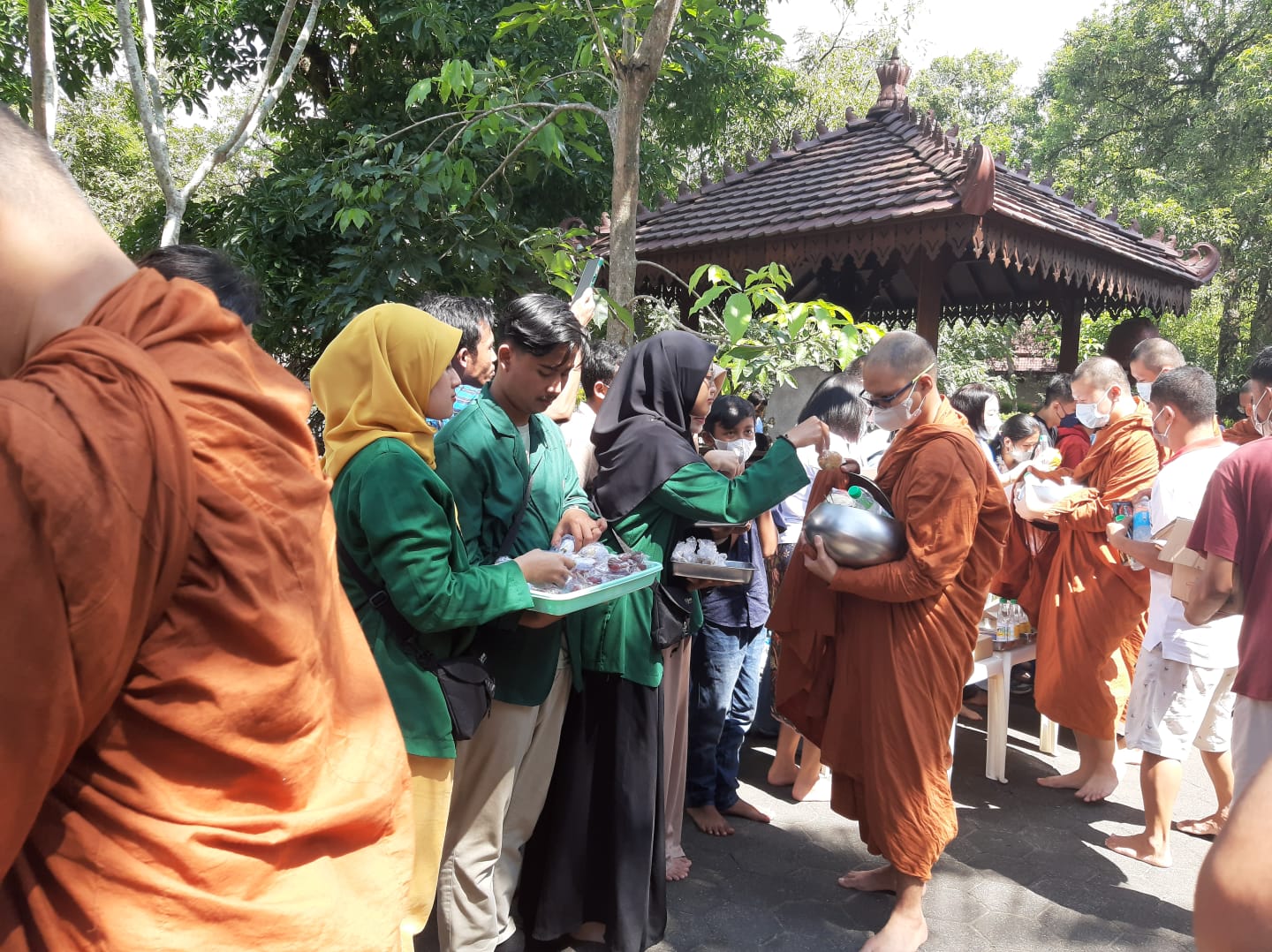
KKN Moderasi Beragama UIN SUKA Ikut Prosesi Pindapata
Berita Baru, Jawa Tengah – Kelompok Kuliah Kerja Nyata (KKN) Tematik Moderasi Beragama UIN Sunan Kalijaga Yogyakarta yang di terjunkan di wilayah Kelurahan Mendut, Kecamatan Mungkid, Magelang berkesempatan bertemu dengan Kepala Sangha Theravada Indonesia, Bhante Sri Pannavaro Mahathera saat ditemui di Vihara Mendut pada Rabu (06/07/2022).
Kepada para mahasiswa, Banthe Pannavaro dirinya hidup hanya untuk pengabdian kepada umat, sehingga dirinya tidak mempunyai kekayaan apapun selain kain yang melekat pada tubuhnya.
Banthe menjelaskan prosesi Pindapata merupakan tradisi umat Budha dalam menyambut perayaan Trisuci Waisak. Prosesi Pindapata dilakukan dengan cara para umat Budha memberikan makanan kepada para Bikkhu dan Bikkhuni.
“Dalam prosesi pemberian bahan makanan ada aturan yang harus dipatuhi, misalkan yang perempuan tidak boleh menyentuh secara langsung Bikkhu dan yang laki-laki tidak boleh menyentuh langsung Bikhuni,” tutur Bhante.

Sementara itu, Dosen Pembimbing Lapangan (DPL) KKN Tematik Moderasi Beragama Muhammad Fatkhan mengatakan tradisi keberagamaan masyarakat di Mendut sangat menjalin silaturrahim yang baik dengan Vihara.
“Sebenarnya juga banyak disini umat muslim yang bekerja di Vihara dan itu sudah berjalan bertahun-tahun,” tutur Fatkhan.
Fatkhan menjelaskan pengenalan mahasiswa KKN kepada kegiatan langsung umat Budha di Vihara merupakan suatu bentuk pengalaman keberagamaan yang sangat baik sebagai nantinya dapat diterapkan ketika ia sudah pulang ke masyarakat.
Lebih lanjut, Ketua Kelompok KKN Tematik Moderasi Beragama, M. Rezi Muda Putra mengatakan perjumpaan teman-teman mahasiswa dengan Bhante Pannavaro merupakan sebuah kehormatan tersendiri, apalagi mahasiswa juga diajak untuk ikut bersama membagikan makanan kepada para Bikkhu dan Bikkhuni.
“Ini menjani pengalaman yang luar biasa, dimana kita dapat berinteraksi langsung dengan umat agama lain. Dan ini sangat mencerminkan keberagamaan yang sangat patut menjadi sebuah contoh,” katanya.
Rezi berharap ke depan kelompok KKN juga dapat berpartisipasi dalam kegiatan-kegiatan yang ada di Vihara.
“Hal ini penting sebagai bekal kita nanti ketika sudah selesai studi dan pulang ke masyarakat,” pungkasnya.
Baca Selengkapnya

The Questions of Human Rights?
Pewartanusantara.com - The current debate concerning the democratic institution is about how we elaborate on the question of to what extent are human rights being alright? Since the government incrementally increases their capacity to control and assist human conditions, there is a bounce of law issues that should be legalised in order to secure citizens and society and make explicit the rule of government. But the mechanism of democracy tends to construct the relationship between the ruling authority and the subject of citizens always in dialectical tense.
On the one hand, citizens want protection—based on their recognized rights—from the state. And the other, the state must be obliged to provide it through law as the rule of game. However, this dialectical tention is never monolithic because society has complex interests.
The revision of the Roe vs. Wade case nowadays can be said a clear sign of the dialectical mechanism of a democratic society. That case surely is a result of the development of the American regulation system that is based on liberalism. Liberalism can be understood as an ideology that insists on individual choices. This ideology tends to celebrate and encourage self-expression and personal decision. But, for some people, in a certain condition personal preference must be regulated.
For instance, a condition that lies in abortion. This abortion issue thus becomes a public debate because of the variety of arguments about whether the pregnancy is better decided to continue or to end with certain conditions. This debate then has been simplifying between the pro-life vs. pro-choice.
Barrack Obama, former American president, commenting the overturn of the Roe case as an effort to reduce human freedom. Then, he called the American people to involve in activism and support the local protest. From political point of view, this new legal framework is actually influenced by conservative arguments that prioritize public morality over personal decisions. It is also the effect of the American political situation since Donald Trump holds the power.
This situation, which is worsened by inequality and the wane of hegemonic power, made civic life in America experience polarization. In other words, the American political outlook tends to handle the socio-economic problems by withdrawing from their previous paths. It seems clear in Trump’s restriction of economic policies.
Such a scene lifts me to ask deeper about how we understand human rights. Maybe we should comprehend that human rights are a doctrine that demanded a kind of recognition of the essential rights that were embedded since we were born.
The scope of human rights is broader and covers but is not limited to the right to life, the right to have an identity, the right to have culture, the right to determine the self and etcetera. But we have to consider that the universal claim about human rights assumes that the embodied individual is its main object.
This necessarily requires biological approach to construct the features of human rights. Therefore, human rights are permanently possessed by human living.
From this point, thus, when human living actually carries out human rights? It is a simple question but also sometimes problematic. Because human living cannot be born or exist without the women's body, human rights have a contradictory problem to approach pregnancy.
It is a transgressive case while the agent of reproduction of human living also has the right to decide their body. This specific feature is thus confusing when we consider the different moral stances and the complexity of the actual condition at stake.
From religious perspective, the moral stance about this issue is how to accommodate and accept human living whatever conditions are. In contrast, the liberal perspective tends to take seriously the actual conditions and insists that the agent take full responsibility for their choices.
This is why human rights are nothing other than the realms of contestation to seek the balance between personal life and communal interest. It is also the tension between individual preference and public morality. Then, what is the significance of human rights? It is nothing other than a universal truth that we accept to be a fundamental value in our modern worlds. But, as a human concept, human rights have no idea about what made humans alive. In other words, human rights are based on the materialist paradigm. Therefore, the objective of human rights is how to secure the human body, and something attributed to it from outside harm.
I suppose this conceptualization impoverishes the human universe in which the meaning of life is not limited to the body but also the spirit or soul. However, the insistence to secure a human integrated body is one virtue that we must accept. The problem is, then, when it is being regulated by institutional power that can coerce, not secure, humans in a certain direction.
Baca Selengkapnya

Technology, Energy and Welfare Society
Pewartanusantara.com - Since technologies took a pivotal role to transform the medieval age into modern times, there is the insistence that technological advancement would bring welfare to the society. The invention of the printing machine enables the circulation of scientific works and philosophical arrangements to flow smoothly. In such conditions plus the supply of natural resources from the colony European civilization grow faster. This is the beginning of the modernity ethos that is well known as the idea of progress.
The idea of progress is the vision of individuals and society to archive well-being. The meaning of wellbeing is nothing other than a condition in which the material resources is sufficient to fulfil the needs and the necessity of symbolic capital to guide and organize human being. In the other words, this concept has been accepted to be the mode of existence in modernity. Furthermore, this specific historical development has been transmitted across the world in order to establish the legitimacy of the Western framework. But one obvious thing is that the competition for power in the modern world is primarily about control over natural resources. Besides that, advancement in technology is needed to maximize the production process.
In the early twentieth century, the one-line manufacturing industry has been developed to increase production with a limited amount of energy. It is a combination between human capacity and machine power. At the time, we witness that electric power has been used effectively to reach optimum production. This is the reason why the motor factories such as Ford became one of the biggest factories in the first half of the 20th century. But the manufacturing industry is also the main source of state revenues. Therefore, the state has interested to make a policy about securitizing and prioritizing the industry.
Today, energy can be said as the “oxygen” of our globalized world. Without energy, all businesses would be paralyzed. Our secondary oxygen lies in two things, that is the electricity and the fuel. We frequently perceive such energies as taken for granted. It means that it always exists and is available. But the fact is not so, contrasted indeed. Energy, as it can be used for pragmatic goals, is a limited resource. It might be available because we enable to produce in constant amounts and establish an integrated chain distribution. In other words, energy is an economical management issue.
While we evaluate our energy consumption in daily life, the amount is higher when we possess electronic devices. Our daily activities, for example, watching movies, browsing websites, accessing social media, and working tasks, consume a certain amount of energy. But we seldom consider that the use of electricity or fuel in our daily life contributes to the worsening of the atmosphere and climate change. We tend to perceive our electronic devices as a sign of welfare. Further, the new launched electronic devices with smarter features are attractive when we have accepted the idea of progress.
Read also: Making Political Myths: The Fate of Democracy in the Age of Information
This is the irony of modern society. We have created a social condition in which the extraction of natural resources is required to generate energy and develop the economy. But as a member of society, we did not realize that the used energy surely has long-term and large-scale impacts that we call crises. And I must assert that the crisis of energy is more dangerous and lethal than the financial crisis. Maybe, this crisis would not have occurred as long as the natural source of electric energy such as coal and fuel such as crude oil is arranged to be available. From such analysis, the relation between energy and welfare is stronger when society utilizes technology to increase its productivity. Our modern society manages to ground out technological advancement as the locomotive to pursue wellbeing. This lie in the mechanism in which the technology (of information) gains a prestigious position and is valued with high expectation. This made the fate of modern society vulnerable and dangerous because the circulation of information and mobility necessarily needs a constant amount of energy and it is increasing every day. To supply that energy, diversified explorations of natural resource across the world is needed. One possible thing is that in the future the crisis of energy leads the human tragedy and lethal conflicts.
Baca Selengkapnya